Plastic Additives, Recycling & PCS
The "biodegradable ruins recycling" argument only holds if recycling works. It doesn't. Here's what the data actually shows.
There is an argument you have probably heard, maybe even repeated. It goes like this: we should not make packaging that breaks down, because if people know the bottle will eventually break down, they will stop caring. They will litter. They will toss things in the trash instead of the recycling bin. And the whole beautiful machine of recycling, the one turning yesterday's bottles into tomorrow's bottles, will grind to a halt.
It is a tidy argument. It has a hero (recycling) and a villain (the careless consumer) and a moral (protect the system).
There is only one problem with it. The system it is protecting does not work.
The number nobody wants on the poster
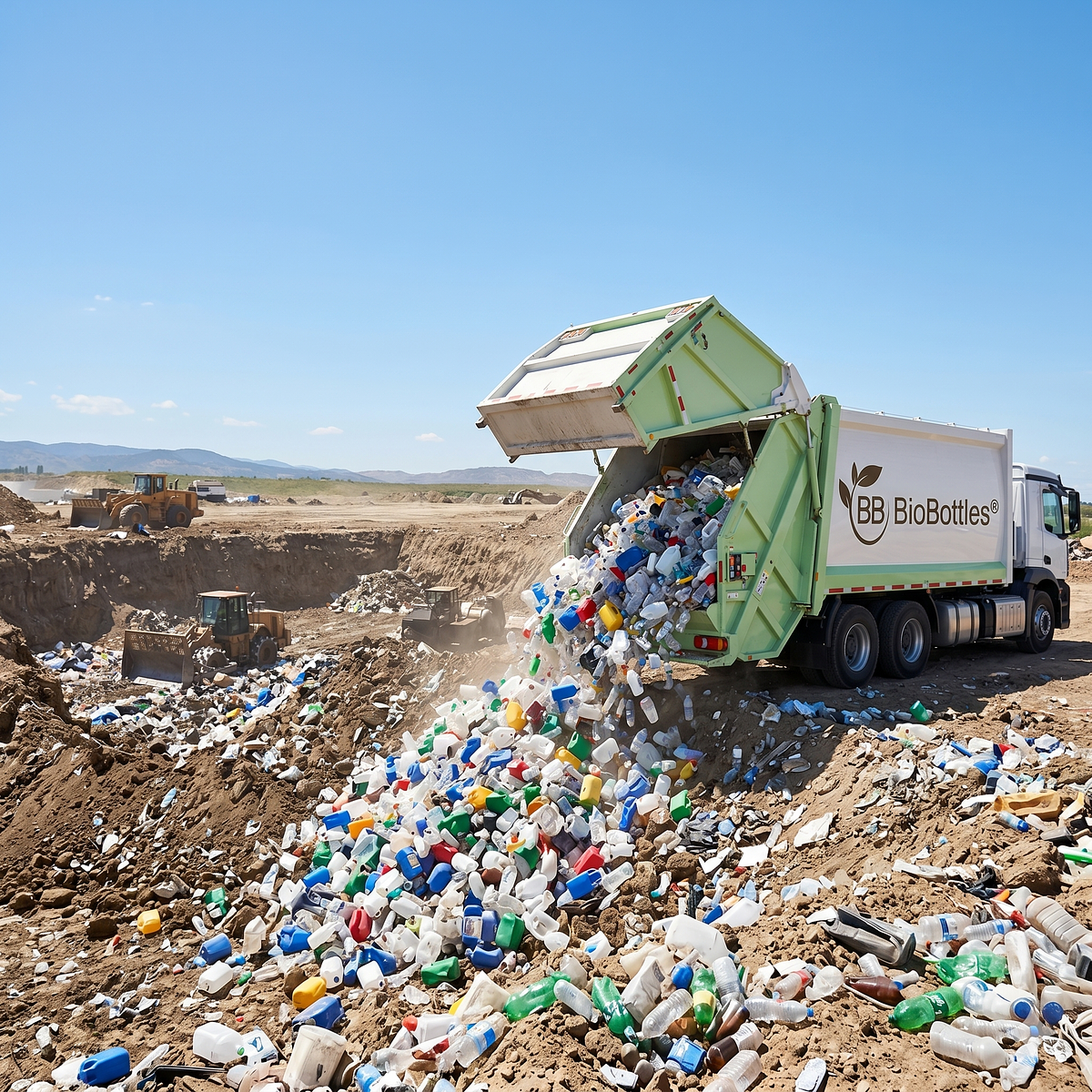
Here is the figure that quietly demolishes the whole thing. Of all the plastic waste the world generates, roughly 9% gets recycled.
Not 9% this year because of a bad quarter. Nine percent as the working average. That is the number from the OECD's Global Plastics Outlook, and once you have seen it, the litter argument starts to look strange. Around 50% of plastic waste goes to landfill. About 19% is incinerated. And roughly 22% is mismanaged, meaning it never makes it into a controlled system at all. It ends up in a ditch, a river, a gutter, the sea.
Read that again. The recycling bin, the thing we are told the future depends on, catches fewer than one item in ten. The other nine are landfilled, burned, or simply loose in the world.
So when someone says biodegradable packaging will "make people litter and ruin recycling," pause on that. Ruin what, exactly? You cannot ruin a system that already fails nine times out of ten. The argument only makes sense if you believe recycling is a functioning machine humming along at high efficiency, quietly saving us. It is not. It never has been, not for the vast majority of plastic ever produced.
Who benefits from you believing otherwise
If recycling barely works, why does everyone act like it does?
Because a lot of people need you to believe it. If recycling is viable, then the plastic problem is solved on the back end. No need to redesign the bottle. No need for new rules. No need for anyone to change anything, as long as you, the shopper, keep rinsing your containers and putting them in the right bin.
"Please recycle" is a wonderful phrase for a company to print. It moves the responsibility from the people who made the plastic to the person who bought it. It buys time. It softens the pressure for regulation. And it does all of that whether or not the item on the shelf ever actually gets recycled anywhere near you.
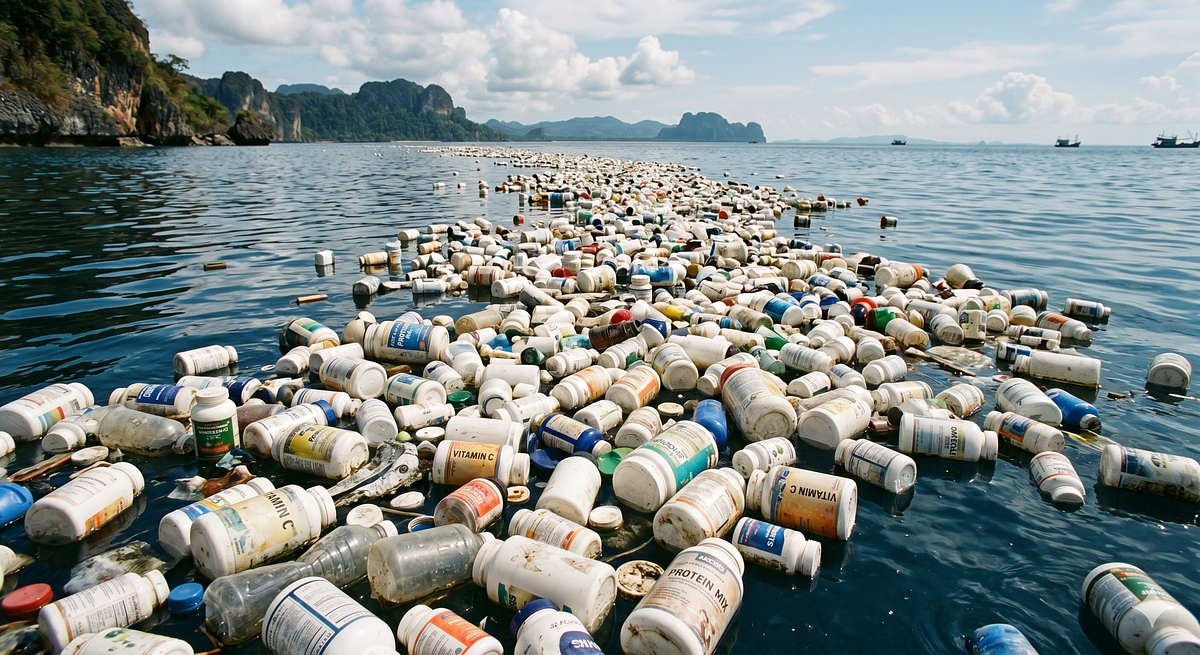
Meanwhile the 91% that never gets recycled keeps piling up. And the fate of that 91% is where the real story lives.
What actually happens to plastic that escapes
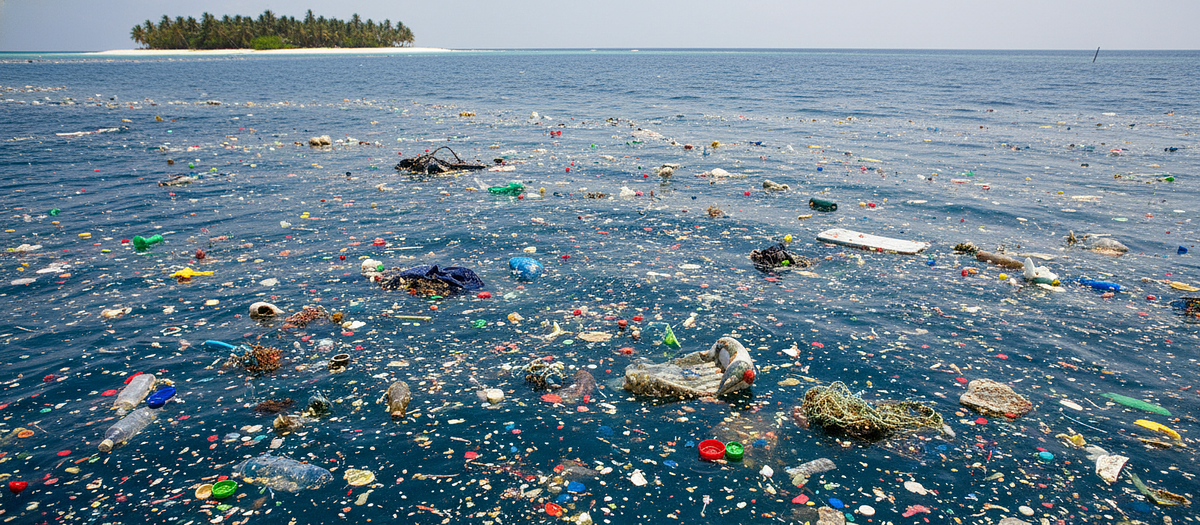
Follow one ordinary supplement bottle. You finish it, and for whatever reason it does not make it to a recycling program. Maybe your area does not take that shape. Maybe it blows out of a bin. Maybe it just goes in the trash, the way most plastic does.
Now it is out in the world. Sunlight hits it. Heat, rain, wind, time. Ordinary plastic does not vanish. It does something worse. It goes brittle and shatters into smaller and smaller pieces, then smaller again, until the fragments are too tiny to see. Those fragments are microplastics, and they do not stop. Conventional plastic is estimated to persist in the environment for 400 to 500 years, shedding fragments the entire time.
This is not a distant, abstract problem. Those fragments are turning up inside us.
"A 2024 study in the New England Journal of Medicine found microplastic fragments in human arterial plaque, and linked their presence to a significantly higher risk of heart attack and stroke."
Microplastics have been detected in human blood. In placentas. In breast milk. Researchers at Fudan University and Duke University reported in 2026 that microplastics accumulating on the ocean surface increase how much heat the water absorbs. The tiny bits from the bottle you tossed do not disappear. They relocate. Often into a body.
So here is the contradiction sitting at the heart of the "biodegradable ruins recycling" argument, stated plainly:
The people warning that biodegradable materials will make you litter are defending a system that already loses 91% of what it touches. And the plastic that escapes that system right now, today, is fragmenting into the microplastics showing up in human arteries. The litter problem they are afraid of? It already exists. It is worse than they fear. And their solution is to keep the current plastic exactly as it is.
Same escape, different ending
Now run the same bottle again. It escapes containment, exactly as before. Sunlight, heat, time.
But this time the bottle was built differently. The difference is built into the bottle itself, so that when it is out in the environment exposed to oxygen, heat, and UV light, the plastic does not simply shatter and stubbornly persist. Instead of fragmenting into microplastics that linger for centuries, it breaks down safely. The material's structure comes apart, converts into a waxy substance, and bacteria consume that into biomass, water, and CO₂.
Same escape scenario. Completely different outcome for the person downstream who later drinks the water, or breathes the air, or eats the fish.
That is what GreenFrog Packaging builds into BioBottles®. Not a promise that you will always recycle perfectly. A different answer for the very likely event that a bottle, somewhere, does not get recycled at all.
The master claim is deliberately short. No microplastics. Please recycle. Both halves matter. Recycle when you can, because recycling is good when it happens. But for the enormous share of plastic that never gets recycled, the bottle itself is designed so that escape does not mean a 500-year microplastic legacy.
"But won't that wreck recycling?" (the actual evidence)
This is the fair question, so let's answer it with data instead of vibes. The worry is that a bottle built to break down would poison the recycling stream, weakening every batch it lands in.
It does not. And that is not a hope, it is a tested result.
A rigid HDPE bottle made with this technology was run through the Association of Plastic Recyclers' own Critical Guidance Protocol for HDPE rigid containers, HDPE-CG-01, the testing method US recyclers actually use to decide whether a material belongs in the stream. The lab, AIMPLAS, ran it in December 2023, report AST-23-203. The conclusion: no disconformities were detected in any of the samples, all within the recycler benchmark.
It gets more specific:
- It was tested not at some trace level but at 25% and 50% of the blend, far above anything a real municipal stream would ever see.
- Tensile strength at 50% inclusion measured 27.6 MPa. The control, ordinary HDPE, measured 27.6 MPa. A difference of zero.
- It floated in the wash and sink/float steps that actually sort the stream: 100% flotation, no sinking particles. It sorts as HDPE because it is HDPE.
That is the direct test on the exact kind of article, a rigid bottle, using the American recycling industry's own protocol. And it is not alone.
- Roediger Agencies (2010) found that adding up to 25% regrind of this material to recycled polyethylene made no difference to the outdoor life expectancy of the finished product.
- A European polymer institute, TCKT (2016), concluded the additive is "most unlikely to prevent compliance" with the European standard for packaging recoverable by material recycling.
- Grupo Bimbo has run this material through industrial-scale recycling for roughly fifteen years with no reported problems. That is the real world, not a lab bench.
There is a citation worth knowing about here. The claim that these plastics harm recycled material quality is often traced back to a peer-reviewed 2012 paper by Jakubowicz and Enebro. Read the paper itself and its conclusion is the opposite: incorporating minor fractions of this material into existing recycling streams "will not create a severe effect on the service life of the recyclates," as long as the mixture has a reasonable degree of stabilization, a condition that is routinely met. The source cited to prove the danger actually reassures for realistic conditions.
So the bottle that protects you if it escapes does not sabotage the 9% that does get recycled. It flows through the same HDPE streams. Recyclable where programs exist, and local programs do vary, so check yours.
The part of "recycling" that should genuinely worry you
Here is where the story turns, because there is a version of recycling that is being sold as the clean answer, and it carries a risk almost nobody talks about.
Post-Consumer Recycled plastic. You will see it abbreviated as PCR, sometimes PCS. It is plastic collected from used consumer products, cleaned, and remade into new packaging. On the label it sounds unambiguously good. Recycled content. Circular. Responsible.
Now ask a question the marketing does not answer: what was that plastic used for before?
Because "post-consumer plastic" is not a pristine, uniform stream. It is a mixed river of whatever people threw away. Bottles that held drinking water, yes. But also containers that held pesticides. Solvents. Motor oil. Household chemicals. Industrial cleaners. All of it goes into the same collection stream, and the sorting and washing that follows is not a molecular scrub. It is mechanical.
Peer-reviewed work has flagged exactly this. Studies published in journals including *Environmental Science & Technology* have documented hazardous chemical residues surviving in recycled plastic resin, contaminants that came along for the ride from whatever the plastic previously contained and were never fully removed. Investigative reporting on recycled resin has raised the same alarm: the recycled pellet that becomes your next bottle may carry a chemical history you cannot see and were never told about.
Now stack that against where recycled content is increasingly ending up. Food packaging. Personal care products. And supplement bottles, the ones holding the capsules you take precisely because you are trying to take care of yourself.
"Imagine buying a supplement to improve your health, in a bottle made from recycled plastic that once held an industrial chemical, with residue no one fully cleaned out and no one is accountable for."
That is the uncomfortable core of it. There is no single global authority standing at the end of the line verifying that recycled resin destined for your vitamin bottle is free of the residues from whatever it used to be. No agency owns that job. When something goes wrong, there is no one whose name is on it, no one cleaning it up.
This matters for the debate at the top of this article. "Just use more recycled content" is offered as the mature, responsible alternative to rethinking the plastic. But recycled content is not automatically safe content. Feeding contaminated post-consumer plastic back into packaging that touches food and supplements is not obviously a solution. In some cases it is a new problem wearing the costume of the old one's answer.
None of this means recycling is bad. It means recycling as it actually operates is neither as widespread as we pretend (9%) nor as clean as we assume (uncontrolled contamination in the stream). Both of those facts undercut the idea that the current system is a finished thing worth protecting from every alternative.
What this looks like on a shelf you actually use
Strip away the studies for a second and put it in a kitchen.
You have a bottle of magnesium capsules. Ordinary plastic. It does its job. It holds the capsules, it seals, it survives shipping. When you are done, it goes wherever your local system sends it, which, statistically, is not a recycling plant. It joins the 91%. Over the next few centuries it fragments into microplastics.
Now the same bottle, built with the difference baked in. It holds the capsules just as well. It runs on the same filling lines the brand already owns, so nothing changes for the company making it, and it costs only a few cents more per unit. It is recyclable through the same HDPE streams where those programs exist. But if it does not get recycled, if it ends up in the 91%, it does not spend centuries shedding fragments into water and soil and, eventually, people. It breaks down safely instead.
Nothing about that requires you to litter, or to care less, or to stop recycling. It just changes what happens in the very common event that a bottle escapes the system anyway.
The questions a skeptic still has
"Won't people just litter more if they know it breaks down?"
This is the original fear, and the honest answer is that it is a strawman built on a broken foundation. The litter and escape problem is not hypothetical, and it is not caused by people relaxing because their bottle is different. It is happening right now with ordinary plastic, at massive scale, which is exactly how 22% of plastic waste ends up mismanaged in the open environment and roughly 91% never gets recycled at all. A bottle built to break down safely does not create the escape problem. It changes the consequence of an escape problem that already exists. And nobody is claiming you should stop recycling, the claim is literally the opposite: recycle, and choose a bottle that does not leave microplastics if you cannot.
"Isn't recycled content always better than new plastic?"
Not always, and this is the part the label will never tell you. New plastic made for food contact starts from a known, controlled material. Post-consumer recycled plastic starts from a mixed stream that may have carried pesticides, solvents, or industrial chemicals, with residues that mechanical washing does not guarantee to remove and that peer-reviewed studies have found surviving into the recycled resin. "Recycled" answers where the plastic came from. It does not answer what is in it now. For packaging that touches food and supplements, that is not a small distinction.
"Who tested this, and why should I believe it?"
Fair, and specific answers exist. The recyclability was tested by AIMPLAS to the Association of Plastic Recyclers' own protocol on an actual rigid bottle, with zero difference in strength versus regular HDPE at inclusion rates as high as 50%. The breakdown behavior is validated by independent laboratories including Jordi Labs in the US, and research from Queen Mary University of London found this kind of material breaks down up to roughly 90 times faster than ordinary plastic while being non-toxic on land and at sea. The bottles are also FDA food-contact compliant. None of that is a slogan. It is testing with report numbers and named labs behind it.
"So is recycling pointless?"
No. Recycling is good when it actually happens, and the goal is not to give up on it. The point is narrower and more honest: recycling captures a small fraction of plastic, so a bottle should also be built for the far more likely case where it never reaches a recycling plant. Do both. Recycle where you can. And pick packaging that does not leave a microplastic legacy when the system misses it, which it usually does.
Back to the poster
Remember the tidy argument at the top. Recycling is the hero, the careless consumer is the villain, and biodegradable materials are the threat that will make everyone stop caring.
Now hold it up against the numbers. A hero that saves 9% and loses 91%. A "circular" answer, recycled content, that can quietly carry the chemical residue of whatever it used to hold, with no agency accountable for checking. And a fear of littering aimed at packaging designed to protect people precisely when litter happens, while ordinary plastic does the fragmenting the fear pretends to prevent.
The question worth asking is not whether breakdown-designed packaging will ruin recycling. It is whether we can keep calling something a solution when it has only ever worked for one bottle in ten.
If you have a supplement brand you love, that is a fair thing to bring up with them. Which would you rather your bottle become in a hundred years: a cloud of microplastics, or nothing at all?
Sources
Every claim above is drawn from the following. Where we are permitted to host the document we have; where the publisher holds it, the link goes to them.
- AIMPLAS, APR Technology Validation of HDPE Rigid Containers, report AST-23-203-part1-EN/1, 4 December 2023. (PDF)
- Roediger Agencies cc, analytical laboratory report to Symphony Environmental Technologies PLC, 24 November 2010. (PDF)
- Burgstaller, C. & Reisecker, V., TCKT, 17 March 2016. (PDF)
- Burgstaller, C. & Reisecker, V., TCKT, 27 July 2016. (PDF)
- Jordi Labs, independent review, November 2024 (signed January 2025). (PDF)
- Jakubowicz, I. & Enebro, J., Polymer Degradation and Stability 97(3), 316–321, 2012. (at the publisher)