Single-Use Plastics: Everything You Need to Know
The truth about single-use plastics, the recycling loophole that fooled us for decades, and what actually breaks the cycle.
A plastic fork touches your lips for about eleven minutes. Then it spends the next five hundred years not going anywhere. It outlasts the meal, the restaurant, the person who served it, and the great-great-grandchildren of the person who threw it away. We call it "single-use." The use is single. The plastic is forever.
That gap is the whole story. The convenience lasts minutes. The material lasts centuries. And the people who profit from making it told you not to worry, because the little symbol on the bottom meant the problem was already solved.
It did not mean that. It never meant that. The name is the lie.
The word that got rewritten
Here is the trick, in plain terms. "Recyclable" was redefined to mean a material could be recycled somewhere on earth, under ideal conditions, by some facility that may or may not exist within a thousand miles of your kitchen. Not that your town will take it. Not that anyone will. Just that it is theoretically possible.
Regulators let the plastics industry write those definitions, then pointed at the resulting labels as proof the problem was handled. They changed what the word means, then used the label as evidence they had solved the problem. The public sorted, rinsed, and binned in good faith for decades.
"The global recycling rate for plastic has never exceeded about 9 percent."
Read that again. For every ten plastic items you have ever carefully sorted, better than nine went to a landfill, an incinerator, or the environment anyway. You were doing unpaid labour for a system designed to make you feel like the labour mattered.
Why anyone wanted it this way
Recycling did not become "the solution" by accident. Petrochemical producers lobbied hard for it, because recycling kept the spotlight on your bin and off their factories. As long as the conversation was about consumer sorting, the thing that actually makes them money, virgin plastic production, stayed untouched.
The U.S. plastics industry spent $50 million telling you to recycle between 1990 and 2020; actual recycling infrastructure received a fraction of that, the ad campaign was cheaper than the fix. So they bought the campaign.
The symbol that promises nothing
The three chasing arrows you have trusted your whole life? No government body owns them. No regulator verifies them. In most places, a company can stamp that loop onto almost anything with zero legal obligation to ensure a single piece of it is ever recycled.
A bottle no facility in your county accepts gets the same three arrows as something with a real recovery rate. Same green halo. Wildly different endings. You are probably thinking there is no way that is legal. It is.
You are paying for this twice

First at the till, when you buy the product. Then again in your taxes, for the landfill space and the coastal clean-up the manufacturer never funded. The plastic that escapes does not vanish. It crumbles into microplastics, turning up in human blood, lung tissue, placentas, and now arterial plaque.
Researchers found those microplastic fragments lodged inside arterial plaque. People who had them were 4.5 times more likely to have a heart attack, stroke, or die within three years. The fork was eleven minutes. The fragment is permanent. (New England Journal of Medicine, 2024.) A separate 2026 study from Fudan University and Duke University, published in Nature Climate Change, found microplastics darkening the ocean surface and trapping heat at a scale researchers compared to running roughly 200 coal-fired power plants.
That is what the recycling symbol was protecting you from having to think about.
What actually breaks the loop
So if the label is a permission slip and the symbol is a trademark owned by no one accountable, what do you do instead? You stop trusting the promise and start checking the disposal. And you look for formats where the primary guarantee does not depend on your municipality cooperating, because this piece has just established how that turned out.
The category to look for is packaging engineered to break down without shedding persistent microplastic fragments if it escapes, and already audited against real-world disposal infrastructure, not theoretical lab conditions. That is the direct answer to the specific lie named at the top: not "recyclable under ideal conditions somewhere on earth," but verifiably inert if it escapes, regardless of what your local programme does or does not accept.
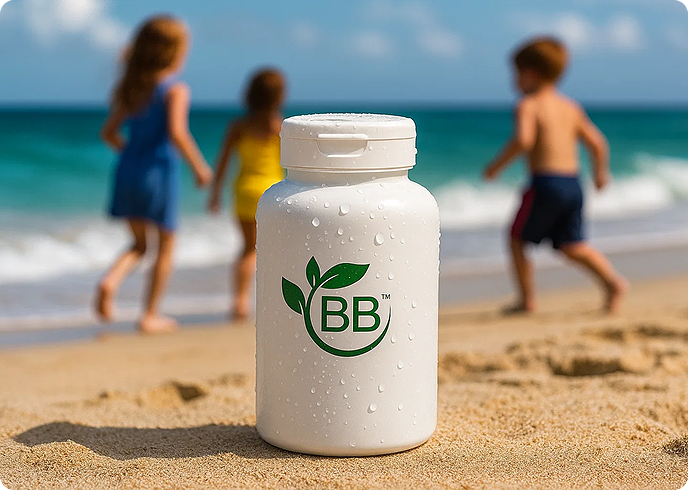
One example already on shelves is BioBottles®, bottles built with PlasticIQ® technology and paired with BioCaps®. If a bottle escapes into the environment, it is engineered to help prevent the persistent microplastic fragments ordinary plastic leaves behind. It stays fully functional on the shelf and can be recycled through existing HDPE and PP streams where those programmes exist, and yes, local programmes vary, which is precisely the tension this piece has spent every paragraph building toward. The reason that partial recyclability does not undercut the argument is that the primary claim is about what happens when recycling fails, as it does more than nine times in ten. No microplastics if it escapes is the relevant guarantee given everything we just proved about recycling rates.
Other routes exist. Plant-based bioplastics like PLA need industrial composting facilities most regions do not have, so they often end up in the same landfill as everything else. Paper and fiber swaps trade away the protection and shelf life that liquids and supplements actually need. The claim here is narrower and it is verified under ASTM D6954 testing: no microplastics. Please recycle, but the promise does not depend on it.
The ask
Before you buy a package, take thirty seconds and search whether your local authority actually accepts it. One quick check is worth more than any symbol printed on the box, because you now know what those symbols are, and are not, required to mean.
The bin was never the problem. The promise printed above it was.