The Truth About Biodegradable Plastics & Recycling
How a citation chain, not a lab result, keeps a clean plastic additive out of recycling streams, and what the testing actually shows.
The Contaminant That Was Never Tested
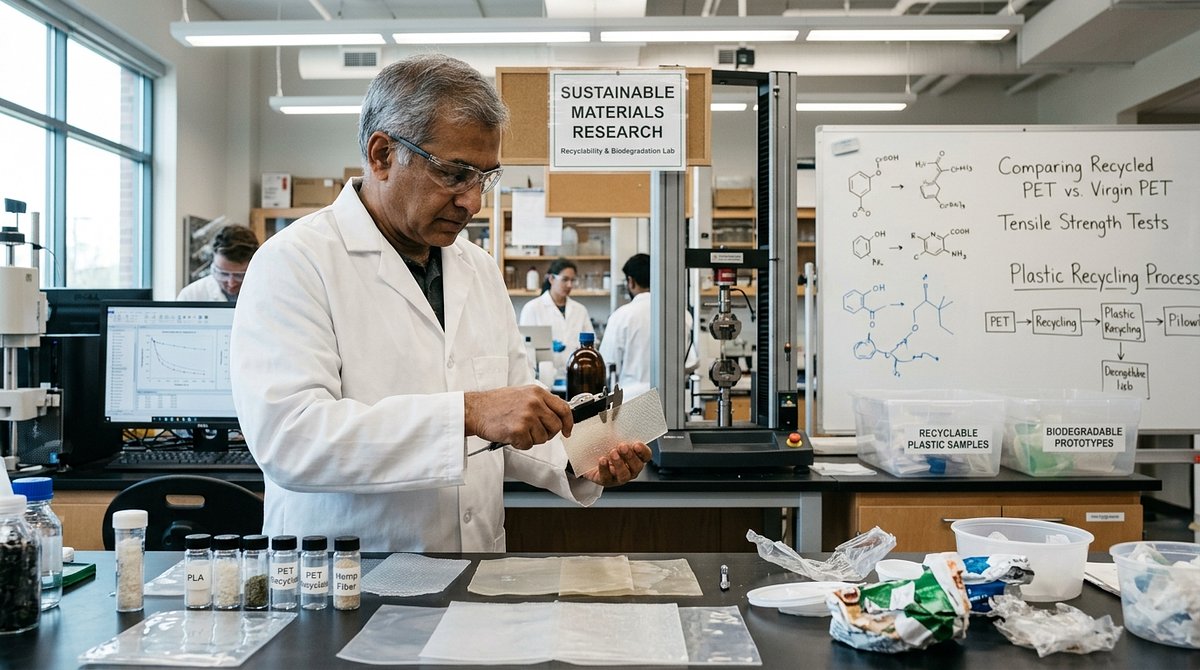
Additives like the PlasticIQ® additive used in BioBottles®, that recycling-industry bodies and government regulators keep flagging as a recycling stream contaminant has, in a striking number of cases, never been tested by the bodies doing the flagging. Outside the USA, entire countries are using this technology to stop microplastics and are also recycling it, but somehow in the USA, no one wants to acknowledge the science or testing done that proves the additive does not hurt recycling.
The exclusion in the US is not due to a laboratory result. Its origin is a chain of citations. Watch how the chain forms. One authority writes a policy against a class of additive. A second authority cites the first. A third cites the second. Each link borrows the authority of the last without adding a single new measurement. And by the time the guidance lands on the desk of a recycling technician or a state legislator, it reads like settled science.
Follow that chain down to the bottom, though, and something strange happens. The study holding the whole stack up often tested a shopping bag. Or a mulch film. Or nothing at all. A finding about a twenty-five-micron carrier bag gets treated as though it governed every plastic article ever made with an additive in it, including a rigid wall of high-density polyethylene many times thicker. Those are not the same object. Oxygen does not move through them at the same rate. A conclusion drawn from film does not transfer to a bottle just because both are plastic, yet transfer is exactly what the citation chain performs, silently, at every step.
Here is the part that should bother anyone who cares about their health, the oceans and environment and the massive microplastics issue we all face. Conventional plastic, the stuff sitting protected inside the recycling stream right now, persists in the environment for an estimated 400 to 500 years. It fragments into microplastics as it goes and then it enters our boddies. Meanwhile a cleaner alternative, one engineered so microbes can consume the material far faster once its molecular weight drops, gets barred from the same stream. The durable pollutant keeps its seat. The thing built to break down safely gets shown the door. And the door was never a test result. It was a footnote pointing at a footnote.
You are probably expecting a complaint here. This is not a complaint. The confusion has three things that most manufactured panics never have: a name, a chemical mechanism, and a documented paper trail. All three are on the record. When a mistake has a name and a mechanism and a paper trail, it stops being a grievance and becomes something you can actually correct, one citation at a time, by walking the chain back to where a laboratory was supposed to be and finding out whether anyone ever ran the experiment on the right object.
Almost every argument in that citation chain rests on a single unexamined assumption: that all of these additives are the same thing, and that "the additive" is even the sort of thing you can test for recyclability at all. Both assumptions turn out to be wrong. But you cannot see why they are wrong, and you cannot judge whether an additive belongs in a recycling stream, until you know what an additive actually is.
What a Biodegradable Plastic Additive Is, As a Category
An additive is not a plastic. It is a masterbatch, a concentrated pellet of an active ingredient carried in a base resin compatible with the plastic it will join, so the two mix cleanly in the melt. Almost every argument that follows collapses if you skip that distinction, so hold onto it.
The masterbatch is metered into the melt at the moment of manufacture. When a bottle is molded, the additive rides into the melt stream alongside HDPE, high-density polyethylene, the #2 resin most rigid bottles are made from. When a cap is molded, it rides alongside PP, polypropylene, the #5 resin. The dose is small. Roughly one percent by weight. One percent. Remember that number, because it is the whole point.
The finished bottle looks like an ordinary bottle. It fills like one, seals like one, stores like one. It behaves like one because it overwhelmingly is one: the additive is a passenger at one percent, sitting inside ninety-nine percent conventional plastic. Nothing about the wall thickness, the resin identity, or the way the bottle travels down a filling line changes.
Now the part that keeps getting forgotten. Every commercial HDPE bottle already contains additives. Antioxidants that stop the resin degrading during molding. Processing stabilizers. Slip agents so the bottles do not stick together. Nucleators. UV blockers. Colorants. Add those up and you are often looking at several percent by weight, more additive than a degradation masterbatch contributes.
Nobody asks whether the pigment is recyclable. Nobody asks whether the slip agent contaminates the stream. The questions are meaningless, and everyone in the industry knows they are meaningless, because a bottle is not judged ingredient by ingredient.
That is the sentence to fix in place: recyclability is a property of a finished article moving through a recycling stream. It is not a property of an ingredient. An additive cannot be recyclable or unrecyclable, any more than a single brick can be a building. The only real question is whether the whole article disrupts the process it enters. A good deal of policy has nonetheless been written as though a one percent ingredient were itself the thing being recycled. It is not.
So here is the category in one sentence. A biodegradable plastic additive is a masterbatch, blended into conventional polyolefins at manufacture, at around one percent by weight, engineered to change what happens to the plastic at the end of its life rather than during it.
That definition is deliberately broad, because the category is broad. It holds more than one technology, and the technologies inside it are not variations on a theme. They are chemically distinct, and at the end of a plastic's life they behave in opposite ways. One kind cuts the polymer down until microbes can consume it. Another shatters the polymer into fragments and stops there.
Both are masterbatches. Both sit at roughly one percent. Both blend into the same resins on the same equipment. From the outside they can look like the same idea. They are close to opposites. And treating them as one thing, judging them by one label, is precisely the mistake that has driven decades of confused rulemaking.
If the category holds chemically opposite technologies, the only way to judge them is one at a time, starting with the one inside a BioBottle®.
How PlasticIQ® Technology Actually Works
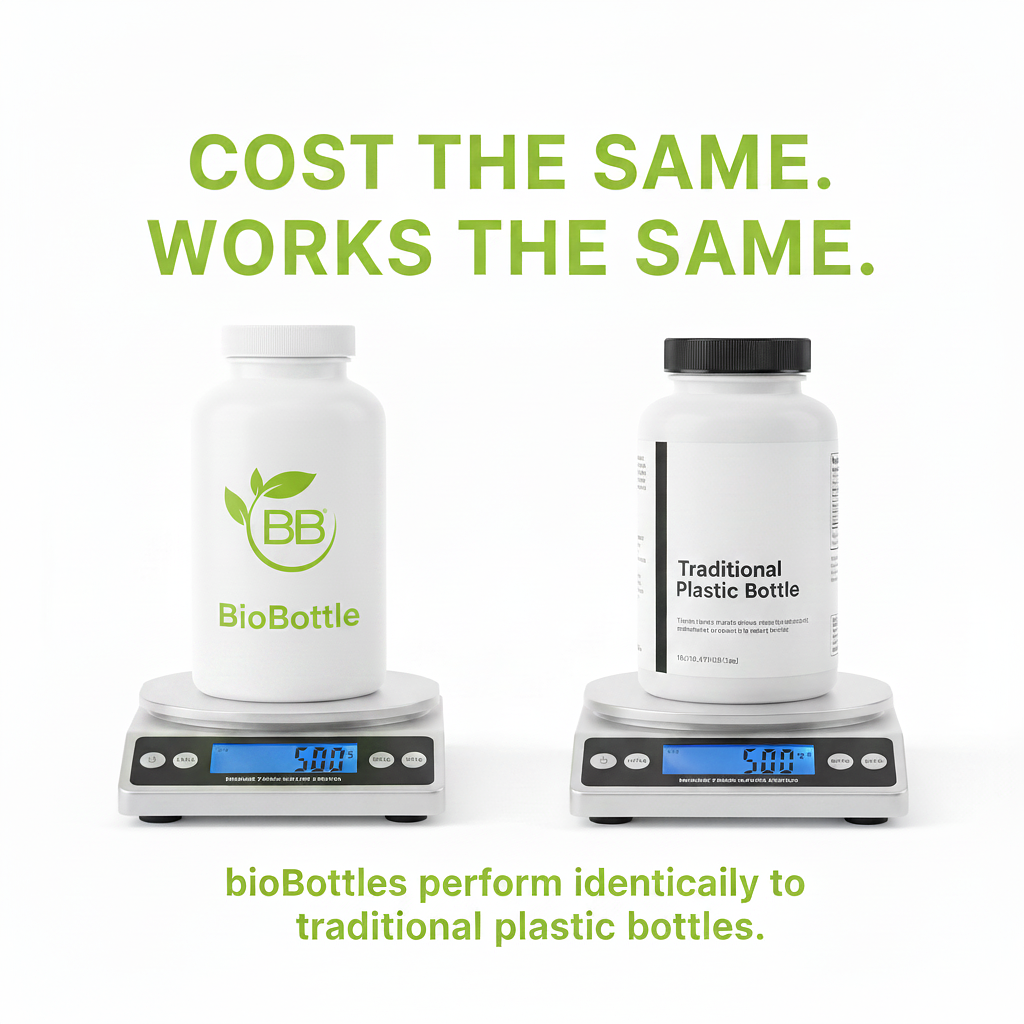
If the category holds chemically opposite technologies, the only way to judge them is one at a time, starting with the one inside a BioBottle®.
PlasticIQ® is a Prodegradant BioPolymer Catalyst. Not an enzyme. A catalyst, meaning it governs a chemical reaction rather than performing one itself. It is integrated into HDPE and PP at approximately one percent by weight. The other ninety-nine percent is an ordinary bottle. So the question this section answers is narrow: what does that one percent actually do?
Start with why ordinary plastic is a problem to begin with. Conventional polyethylene is built from very long molecular chains, above 200,000 daltons in molecular weight. A dalton is a unit of molecular mass, so that number is really a stand-in for chain length. The chains are enormous. That is exactly why plastic is durable, and exactly why microbes cannot eat it. A bacterium cannot get its enzymes around a molecule that size. The plastic just sits there. For centuries.
PlasticIQ® changes what that molecule does at the end of its life. On sustained exposure to oxygen, heat, and UV, the catalyst initiates controlled oxidative chain scission. In plain terms, it helps oxygen cut the long chains into shorter and shorter pieces at a controlled rate. Here is the part worth slowing down for: oxidation happens in any ordinary plastic anyway, slowly and incompletely. The catalyst does not blow the plastic apart. It steers an oxidation nature already performs. It sets the pace.
As the chains are cut, molecular weight falls. It drops from above 200,000 daltons toward below 5,000. Cross under that threshold and the material stops behaving like a plastic. It turns hydrophilic, so it now interacts with water, and it turns bioavailable, meaning the pieces are finally small enough for bacteria and fungi to consume. What was an inert polymer is now a waxy, low-molecular-weight substance that naturally occurring microorganisms treat as food.
They eat it. The end products are biomass, water, and carbon dioxide. In an anaerobic setting, the buried deep of a landfill where methane-producing microbes dominate, methane is among the outputs instead. There is no fragment-and-stop step. No metal shard left behind. No persistent particle sitting in the middle of the process, waiting. The polymer converts, chemically, all the way through.
Professor Ignacy Jakubowicz, one of the field's leading polymer scientists, described it this way: the degradation process is not only a fragmentation but an entire change of the material from a high molecular weight polymer to monomeric and oligomeric fragments, and from hydrocarbon molecules to oxygen-containing molecules which can be bioassimilated. Read that twice. The whole objection people raise, that this just makes smaller plastic, is the thing he is ruling out. The chemistry changes, not only the size.
Two properties answer the questions people ask before they finish asking them.
The process does not depend on sunlight. Light and heat speed it up, but once initiated it continues in dark, cold conditions. Moisture is neither necessary nor preventive. Buried, submerged, in the cold, it keeps going.
And the material is stable in storage. Because the oxidation has to be initiated by sustained environmental exposure, an unexposed bottle simply does not degrade. Rose and colleagues at Queen Mary University of London confirmed exactly this. Their unexposed material showed no significant biodegradation because there had been no reduction in molecular weight, demonstrating that the material is stable in storage conditions. A bottle on a shelf is a bottle on a shelf. It only enters the sequence if it escapes containment.
That end-of-life behavior is verified against ASTM D6954, the international test standard written specifically for plastics that degrade by a combination of oxidation and biodegradation. It runs in three tiers. Tier 1 measures the oxidation and the molecular-weight reduction, confirming the chains actually break. Tier 2 measures the biodegradation itself, the carbon dioxide evolution and microbial assimilation, confirming that something actually consumes the material. Tier 3 confirms the residue is not toxic to plants and earthworms. Three separate questions, three separate passes: does it break down, does something eat it, is what remains safe.
Keep that standard straight, because it measures a completely different question from the recyclability protocols that come later. ASTM D6954 is about what happens at end of life. It says nothing about how a bottle behaves in a recycling stream. Conflating the two is a specific error, and it is one this piece will name directly further on.
So that is the one percent. It waits, inert, through manufacture, filling, shelf, and use. Then, only on sustained exposure, it steers an oxidation down past the threshold where microbes take over, and the polymer converts to biomass, water, and CO₂, with no persistent fragment left in between.
That sequence sounds close to a technology with a terrible reputation, and the resemblance in name is exactly where the damage begins.
The Villain: Oxo-Degradable Plastic and the Terminology Collapse
That sequence, controlled oxidation followed by genuine microbial assimilation, sounds close to a technology with a terrible reputation. The resemblance in the name is exactly where the damage begins.
There is a genuinely bad technology in this space. It is ordinary plastic that fragments and quits. It carries a metal-salt catalyst that helps oxygen snap the polymer into smaller and smaller pieces, and then nothing. No assimilation. No microbe steps in to finish the job. The chains break, the pieces scatter, and the pieces stay. That is oxo-degradable plastic. It earned every bad thing ever written about it.
The formal line between the two is not a matter of opinion. It is written into a standard. CEN TR 15351, the European reference that defines these terms, calls oxo-degradation "degradation resulting from oxidative cleavage of macromolecules." Cleavage, and then a full stop. It calls oxo-biodegradation "degradation resulting from oxidative and cell-mediated phenomena, either simultaneously or successively." Cell-mediated. That is the whole difference in three words. Something living eats what the oxidation leaves behind. In the first case, nothing does.
Now here is the fact that decides everything, and almost nobody outside a polymer lab knows it. The problem is not the size of the fragment. It is the molecular weight. The Lambton Manufacturing Innovation Centre put it plainly: oxo-degradable plastics create microplastics, oxo-biodegradable plastics do not, and the important thing is not the size of the fragments but the molecular weight. A fragment can be microscopic and still be inedible. If its chains are too long, no bacterium can consume it, and it will sit in the soil or the sea for decades no matter how small it gets. Fragment-and-quit plastic produces exactly that: tiny, persistent, high-molecular-weight debris. Microplastics.
And ordinary plastic fragments fast. Lambton records embrittlement and breakup in as little as 4 to 8 weeks of weathering. Four weeks. People assume plastic litter takes a human lifetime to break apart, and the breaking-apart is quick. It is the disappearing that never comes. The fragments persist because their molecular weight stays far too high for any microbe to touch. They just keep getting smaller.
So there are two technologies. One cuts the chains all the way down past the threshold where microbes take over, and the material converts. The other cuts the chains partway and abandons them as permanent litter. Chemically, they are close to opposites.
Then one word swallowed them both.
"Degradable." Regulators reached for it, wrote policy against the fragment-and-quit kind, and the definition landed on everything with the sound of "oxo" in its name. A rule built to stop plastic from shattering into microplastics ended up erasing a technology whose entire job is to prevent plastic from persisting as microplastics. The policy and the target point in opposite directions. The label pointed them at the same door.
The clearest case is the EU restriction. It was written against oxo-degradable plastic, and it did not clearly distinguish oxo-degradable from oxo-biodegradable. Lambton says so directly: the legislation has therefore caused confusion. A rule aimed at fragment-and-quit plastic was drafted in language that blurs the line the standards bodies drew on purpose.
This is why the terminology collapse is the villain of the piece. Not a person. Not a company. A single overloaded word that let a rule written against fragmentation land on a technology engineered to prevent it. The chemistry was never the hard part. The vocabulary was.
Which raises the question that keeps this from being simple. If the two really are chemically opposite, one making microplastics and one preventing them, why do serious recyclers still treat any degradable additive as a threat to the stream they run?
The Recyclers' Fear, Stated at Full Strength
If the two are chemically opposite, why do serious recyclers still treat any degradable additive as a threat to their stream? Because the fear is not stupid. It is disciplined, and it protects something real.
Start with what a recycler is actually guarding. A stream of recycled HDPE, high-density polyethylene, the #2 plastic that most rigid bottles are made from, is a shared resource. Thousands of bottles from thousands of sources get shredded, washed, and melted into one pool of pellets. Every product made downstream draws from that pool. So anything that quietly weakens the recyclate does not spoil one bottle. It weakens everything made from the batch. That is the nightmare, and it is a legitimate one. A recycler is not protecting a product. They are protecting a common good, and a contaminant that degrades the common good is worse than one that ruins a single item.
Now follow the fear to where it bites hardest. Recycled HDPE rarely goes back into bottles. It gets downcycled into long-life goods: plastic lumber, drainage pipe, pallets, decking, signage posts. These products are sold on service life. A pallet is supposed to last years. A drainage pipe is supposed to last decades. The entire value proposition is durability. So imagine an additive engineered to make plastic oxidize and break down. Now imagine a trace of it surviving reprocessing and sitting inside a batch of pipe destined to be buried outdoors for thirty years. If that additive keeps working, keeps cutting molecular chains after the pipe is in the ground, the recycler has sold a product engineered against its own purpose. You can see why that possibility keeps people up at night.
Then there is the sorting problem, and it is the part that makes a blanket ban feel like the only safe move. A degradation masterbatch rides inside the plastic at roughly one percent by weight. A recycler cannot see it. Optical sorters cannot flag it. It carries the same resin identity, the same #2 code, the same density as every other HDPE bottle in the bale. So a recycler faces a choice with no good middle option. They can inspect and adjudicate every incoming additive on a case-by-case basis, an impossible task at the scale of a municipal facility, or they can draw one line and keep the whole class out. Faced with something invisible that might damage a shared resource, precaution feels like the responsible answer. Keep it out, and you cannot be wrong.
That instinct did not stay informal. The Association of Plastic Recyclers, the APR, the body whose Critical Guidance Protocols set the benchmark by which United States recyclers judge whether a new package belongs in their stream, issued guidance discouraging degradable additives from recycled streams. And because APR guidance carries enormous weight, that position hardened into something close to a de facto national standard. A recycler in one state and a legislator in another both end up pointing at the same guidance. It looks like consensus.
Here is the honest part, and it has to be said plainly. If the additive in question were the fragment-and-quit kind, the metal-salt catalyzed variety that cuts plastic into pieces and never reaches microbial assimilation, this fear would be exactly right. An additive that only fragments, sitting inside a melt destined for a thirty-year pipe, is genuinely bad news. The recyclers are not imagining a hazard. They are describing a real one, for a real technology.
But notice what the whole fear turns on. Does the additive keep oxidizing after reprocessing and shorten the service life of a downcycled product? That is not a matter of opinion. It is a measurable, testable question. You take the additive, put it through reprocessing at realistic and unrealistic inclusion rates, age the result, and measure whether the recyclate weakens. Either the numbers move or they do not.
A reasonable fear deserves the research that would settle it. So why was that research never funded against the modern organic additive?
Why Nobody Ran the Research
A reasonable fear deserves research to settle it. So why did nobody fund the study that would?
Start with when the rules were written. The policies discouraging degradable additives were drafted in an era when fragment-and-quit oxo-degradable plastic was the dominant technology in the category. The rulewriters were looking at a material that shatters conventional plastic into persistent fragments and stops there. That was the threat in front of them, and they wrote against it. What they did not contemplate, because it was not the thing on the table, was a chemically distinct organic additive that carries the polymer all the way down to microbial food instead of leaving fragments behind. The rule was aimed at one mechanism. It landed on both, because it never had a reason to tell them apart.
Telling them apart is not free. To distinguish a clean additive from the fragment-only kind, you have to run the finished article through a recyclability protocol in a laboratory, and laboratory validation to a protocol is expensive. Someone has to pay for the shredding, the washing, the extrusion, the plaque molding, the tensile and density and impact testing. Here is the problem with that math. The recycling stream is a shared pool. No single recycler who commissions the test captures the benefit of the result. If the finding comes back clean, every recycler in the country gets to use it, and the one who paid gets nothing the others do not. That is the textbook shape of a cost that never gets borne. Everyone would like the answer. Nobody has a reason to buy it.
Now weigh the two ways of being wrong, because they do not weigh the same. If a recycler wrongly admits a genuine contaminant, the damage is visible and it is expensive. A weakened batch of recycled HDPE shows up in a downcycled product that fails early, and it traces back. If a recycler wrongly excludes a clean additive, nothing happens that anyone can see. The cleaner alternative simply never enters the stream, the microplastic-shedding conventional bottle takes its place, and no one files a complaint about a batch that was never contaminated because it was never let in. One error is a documented failure. The other is an absence nobody notices. Faced with that asymmetry, a blanket exclusion is not just easier, it is the choice that carries no personal downside for the person making it.
Against a free error and an expensive test, copying costs nothing. So the guidance propagates by citation rather than by experiment. One body writes a rule against fragmentation. State and municipal programs adopt the guidance without amendment, because amending it would mean funding the very research nobody has a reason to fund. The rule spreads. And somewhere in that spread the original target gets lost, so that a policy written to stop plastic from fragmenting into microplastics becomes the primary barrier to a technology whose entire purpose is to prevent that fragmentation.
The scale of what this protects is worth stating plainly. Roughly 9% of plastic waste is recycled. About 50% is landfilled, 19% incinerated, and 22% mismanaged into the open environment. So the stream everyone is protecting from a one percent additive is the stream that handles less than a tenth of the problem, and the blanket exclusion keeps a cleaner alternative out of the ninety-one percent that recycling never touches at all. The policy calls this outcome precaution. What it actually does is hold the microplastic-shedding status quo in place and file the result under caution.
If the barrier rests on a citation chain rather than a test, the obvious question is what the actual testing shows once someone finally runs it on the right object.
The Evidence, Part One: The Rigid Bottle Tested to the Recyclers' Own Protocol
If the exclusion rests on a citation chain and not a test, the question answers itself: run the test. Someone did. On 4 December 2023, AIMPLAS, the Instituto Tecnológico del Plástico in Valencia, Spain, issued report AST-23-203, signed by Sonia Albein Urios. The subject was not a shopping bag. It was not a mulch film. It was the actual rigid HDPE bottle, listed in the report by name: "BioBottles® HDPE with Plastic IQ Technology powered by d2w."
That distinction is the whole reason this report matters more than any other document in the pile. Nearly the entire hostile literature tests films. A carrier bag. A 25-micron sheet. And the physics of oxygen diffusion means a thin film and a bottle wall are not the same object. Oxidation is oxygen-limited, so the thicker the section, the slower it reacts. A bottle wall behaves nothing like a film, which means evidence drawn from film systematically overstates the risk for a rigid container. This is the only laboratory evaluation of a rigid HDPE bottle carrying this technology. It should be the first document a regulator reads. It is usually the last.
AIMPLAS ran it against the protocol U.S. recyclers actually use: the APR Critical Guidance Protocol for HDPE Rigid Containers, HDPE-CG-01, together with the Polyolefin Standard Laboratory Processing Practices O-P-00, following Path 1-A, the colored stream. APR is the Association of Plastics Recyclers, the American recyclers' own body. HDPE-CG-01 is the benchmark by which they judge whether a new package belongs in their stream. Note the standard carefully, because this is exactly the category error this piece keeps warning about: HDPE-CG-01 is a recyclability protocol. It is not ASTM D6954, the degradation standard from the previous section. Different question, different test.
Here is what happened. The bottles shredded to 5mm without any problem. They went through a commercial basic wash, then a sink-float separation, the step that actually sorts the stream. Result: 100% flotation, no sinking particles, behavior indistinguishable from the control. It floats as HDPE because it is HDPE.
Then AIMPLAS did something a real municipal stream would never do to itself. It overloaded the blend. Not a realistic trace of these bottles in a stream, but three formulations: a 100% control, a 50/50 blend, and a 75/25 blend. Fifty percent innovation. Far above any fraction these bottles could ever represent in a live stream.
The plaque properties came back against APR's own benchmarks:
- Tensile strength (ASTM D638): control 27.6 MPa, 50% blend 27.6 MPa, a change of zero. The 25% blend read 27.9 MPa, up 1.1%. APR's benchmark allows a loss of up to 25%. There was no measurable loss at all.
- Density (ASTM D792): 0.965, 0.967, 0.968 g/cm³ across the three. Benchmark: no less than 0.941. Pass.
- Flexural modulus (ASTM D790): up 6.9% and 2.3%. Benchmark: under 25% change. Pass.
- Elongation at break: down 14.8% on one blend, up 44.4% on the other. Benchmark: not worse than minus 50%. Pass.
- Izod notched impact (ASTM D256): complete break, same as the control, every sample. Pass.
The report's own conclusion, verbatim: "no disconformities were detected in any of the samples, being all within the APR benchmark."
One honest note, volunteered here because an opponent will find it otherwise. The report records low melt strength causing some line breakage during pelletizing. It applied to all samples, including the 100% control with no additive in it. That makes it a property of the material and the lab line, not of the additive. The report says so plainly: "All samples experienced some low melt strength."
Be precise about what this is and is not. This is a third-party laboratory validation performed by AIMPLAS to APR's published protocol. It is not APR certification, recognition, or endorsement. Nobody holds that here, and claiming it would be its own kind of error. What the document establishes is narrow and strong: run the actual bottle through the American recycling industry's own recyclability test, at inclusion rates two to four times anything a real stream would see, and it passes every benchmark.
One rigid-bottle validation is decisive on the exact question the exclusion turns on. But recyclers do not only fear the first pass through a shredder. They fear the durability of the recycled product after reprocessing, and that worry needs peer-reviewed data of its own.
The Evidence, Part Two: Recycling and Reprocessing Studies
One rigid-bottle validation settles the exact question on the exact article, but a durability worry that large deserves peer-reviewed reprocessing data too, and that data exists.
Start with the strongest independent paper, because it is the one most often cited against this technology and it does not say what it is cited for. Jakubowicz and Enebro, published in *Polymer Degradation and Stability* in 2012 (volume 97, pages 316 to 321), asked precisely the question a recycler asks: what happens to the durability of recycled polyethylene when oxo-biodegradable material enters the stream. It is peer-reviewed, in a mainstream polymer journal, and independent of us. Be clear about two things up front. It tested two commercial additives, P-Life and Nor-X, not the masterbatch in a BioBottle®, so it is a study of the additive class, not of our product. And it was funded by the makers of those two additives, which the authors disclose. Independent of us, industry-funded by them. Say both, because an opponent who finds it will.
Now the numbers, including the one people leave out. In stabilized LDPE, the kind of recyclate any demanding use is made from, the reference material took 224 days at 70 °C to lose half its elongation. Add 10% P-Life and the result was almost identical. Add 20%, and the time dropped to 67 days. That 20% figure is a real reduction, and it belongs in the sentence. Here is the context that makes it reassuring rather than alarming. The authors extrapolated service lives for every stabilized mixture: 10% P-Life over 50 years, 20% P-Life over 15 years, 10% Nor-X 18 years, 20% Nor-X roughly 10 years. Every one of those loadings was at least 100 times higher than the additive would ever occur in a real stream. The study deliberately overloaded the recyclate by two orders of magnitude and still measured a decade of service life. Its own conclusion: incorporating minor fractions of these materials into existing recycling streams will not create a severe effect on service life, as long as the polymer mixture possesses a reasonable degree of stabilization. Hold onto that condition. It recurs.
Roediger Agencies, an independent polymer consultancy housed in the Institute for Polymer Science at the University of Stellenbosch, ran the direct recycling test in November 2010. They reprocessed d2w film granules into recycled linear low-density polyethylene at 5%, 10%, and 25%, against a control with none, added the standard base stabilization any recycler uses, then aged everything under fluorescent UV and heat and pulled tensile numbers. Yield strength held around 11 to 12 N/mm² across every blend and every exposure point. No downward drift as the additive content climbed. Their final line: after more than 24 months of Southern-hemisphere sun equivalent, there is no evidence that adding up to 25% regrind containing d2w to recycled polyethylene makes any difference to the outdoor life expectancy of an exposed molded product.
TCKT, the Transfercenter für Kunststofftechnik in Wels, Austria, ran two studies in 2016 under Dr. Christoph Burgstaller, a polymer PhD whose work includes thermoplastic recycling specifically. The March study reprocessed d2w films, then shelf-life aged them per the AFNOR TC51-808 standard. Conclusion: the additive is most unlikely to prevent compliance with EN 13430, the European standard for packaging recoverable by material recycling, and the data deduced a shelf life of at least two years for film made from 100% reprocessed oxo-pellets.
The July study is where honesty earns its keep. TCKT took the worst case it could construct, 4mm thick outdoor sections, an application the report says this recyclate would never actually be used for, and weathered them 1000 hours. It found a small effect. Unstabilised samples cracked, with or without the additive, and slightly more cracks appeared when the recyclate was present. Then the finding that resolves it: a standard UV stabiliser, the kind any thick outdoor product already contains, removed the difference entirely. Both stabilised samples came out smooth and uncracked.
Finally, the fifteen years that are not a laboratory. Grupo Bimbo, the largest bread manufacturer in the western world, has recycled this plastic in its bread wrappers at industrial scale for fifteen years with no reported problems, part of some 200,000 tons of oxo-biodegradable plastic supplied across more than 90 countries, a high percentage of it recycled.
Three independent lines of evidence. Three different product forms, film, regrind, and reprocessed pellet. The same qualified answer every time, resting on the same stated condition: reasonable stabilisation, which demanding recyclate already has. Convergence like that, condition and all, is what makes the case credible rather than convenient.
Recyclability proves the stream is safe. It says nothing about whether the material actually biodegrades, so the degradation evidence has to stand entirely on its own.
The Evidence, Part Three: Degradation and Biodegradation Studies
Recyclability proves the stream is safe. It says nothing about whether the material actually breaks down. Those are two different questions, and the second one has its own body of evidence, run by different labs, against different standards. Here it is, in full.
Our strongest published paper carries no company author at all. Rose and colleagues at Queen Mary University of London, working with University College London, published in the International Journal of Molecular Sciences in 2020 (21(4):1176). They built a new method to measure how far a plastic actually breaks down, tracking the carbon dioxide bacteria give off as they consume it. The finding: oxo-biodegradable plastic showed up to 90 times more biodegradation than conventional plastic aged the same length of time. Oxo-LDPE reached under 3 kDa in 450 hours of UV; plain LDPE needed 900 hours to hit the same molecular weight. And they nailed down the mechanism that matters: biodegradability rises as molecular weight falls. Cut the chains, and the microbes can eat.
That is the mechanism, confirmed by an independent university. The rest of the record confirms it from several directions.
Jakubowicz and colleagues (2011) ran a soil test to its end. After two years of mineralization, 91% of the material had converted to carbon dioxide. That is the best peer-reviewed biodegradation number in the field, and it is not ours.
Vaksmaa and colleagues (2023, ISME Communications 3:68), fully independent, used stable-isotope tracing to prove that a marine yeast, Rhodotorula mucilaginosa, actually incorporates carbon from polyethylene into its own cells. Their conclusion states the point directly: photooxidation first is what makes the plastic available to microbes. Oxidation, then assimilation. That is our exact sequence, confirmed by people with no stake in it.
Eyheraguibel and colleagues (2017, Chemosphere 184:366-374) took the oxidized fragments and fed them to a named bacterial strain, Rhodococcus rhodochrous. Ninety-five percent of the oxidized oligomers were biodegraded. Not "fragmented." Consumed.
Intertek tested a plastic made with the d2w masterbatch, the technology inside PlasticIQ®, against ASTM D6954, the three-tier standard that measures oxidation, then biodegradation, then whether anything toxic is left behind. In December 2021 they reported 92.74% biodegradation in 180 days, plus passes on ecotoxicity, prohibited metals, and gel content. You cannot reach 100% in a carbon-evolution test, because some carbon becomes water and biomass rather than CO₂.
OXOMAR was a four-year study funded by the French government, run across four independent laboratories: CNEP, LOMIC, ICCF, and IFREMER. Their conclusion was that oxo-biodegradable plastics biodegrade in seawater, and do so with significantly higher efficiency than conventional plastics. Biodegradation was demonstrated both by the cultured bacterium Rhodococcus rhodochrous and by a natural marine community.
Heimowska and the team at Gdynia Maritime University (2023) followed d2w polyethylene for 48 months across natural weathering, freshwater, and laboratory conditions. Disintegration at 18 months. 81.6% biodegradation at 39 months. Complete bioassimilation at 45 months.
Jordi Labs, a United States laboratory that has specialized in polymer analysis for over 40 years, reviewed the claim in a memo dated 26 November 2024, signed off in January 2025 (job J20692-0). They found it scientifically sound. Their key confirmation: the masterbatch controls the rate of oxidation. It does not itself cause fragmentation, and oxidation does not trigger chemical decomposition. Ordinary plastic oxidizes and fragments anyway; the catalyst governs the pace and carries the material down to a weight microbes can consume.
Two documents have to be handled honestly, because an opponent will find them.
The Dussud marine colonization papers (2018, Frontiers in Microbiology and Environmental Pollution) are peer-reviewed and legitimate, but they carry a co-author, Perry Higgs, from Symphony Environmental. They are not independent, and it is dishonest to present them as such.
And there is a presentation by two EPA scientists, Sahle-Demessie and Mezgebe. Read alone, it is the microplastics attack line in its purest form: it states that pro-oxidant polypropylene will "embrittle, crack and break into pieces and powder within two weeks of weathering." Two things must be said every time it comes up. First, it carries its own disclaimer that the views are the authors' and not EPA policy, so it is research by EPA scientists, never "the EPA says." Second, and more important, it stops at fragmentation and does not follow the material further. Paired with the assimilation evidence above, that gap is the whole point: fragmentation is a stage, not the endpoint. Ordinary plastic stops at fragments. This does not.
Nine studies. Four independent of both us and the manufacturer. Two soil, two marine, one yeast, one named bacterial strain, one four-year government program, one US lab review. They converge: oxidation reduces molecular weight, and microbes consume what is left.
The numbers are settled. But a molecular-weight figure means nothing until someone says out loud what it does, and does not, change about the thing in your hand.
What the Regulators Missed: Absence of Evidence Is Not Evidence of Harm
A molecular-weight figure means nothing until someone says out loud what it does and does not change about the thing in your hand. So before the plain-language translation, one gap in the record has to be named, because it is a gap in logic, not in chemistry.
The restriction against additive-containing plastic is not written as caution. It is written as a finding of fact: that the plastic is not recyclable. That is an affirmative factual claim. And affirmative factual claims carry a burden of proof. "We have not been shown that this is safe for the stream" and "this harms the stream" are different sentences. Only the second one requires the person saying it to produce something.
Now look at how the standard gets applied, and watch it point in two directions at once.
Against the additive, the evidence of biodegradation is called insufficient. Even when it is peer-reviewed. Even Rose and colleagues at Queen Mary University of London, even Jakubowicz on 91% mineralization, even the marine work. Not enough, the argument goes.
For the restriction, harm to recycling is asserted with no study of a rigid container at all. Not one. The exclusion rests on films and bags read across to a bottle.
State it flatly, without heat. One side is asked for proof. The other side is taken on inference. Hold both outcomes in a single sentence and the contradiction is hard to unsee: a plastic that leaves no persistent residue is barred from the recycled stream, while a plastic that guarantees persistent microplastic contamination for four to five centuries is welcomed into it without objection.
The regulatory record on the additive itself is not a mystery, either. After a December 2017 call for evidence, the European Chemicals Agency, ECHA, the EU's own technical body for exactly this kind of question, studied this plastic and advised in October 2018 that it was not convinced microplastics were formed. No dossier justifying a ban was ever produced. State that as fact, not as conspiracy. The study was terminated; the finding of harm the restriction assumes was never written down by the scientists asked to look for it.
And there is a definitional trap worth closing. ECHA defines a microplastic as a particle less than 5 mm, solid, particulate, insoluble, and non-biodegradable. Non-biodegradable is part of the definition. So by the regulator's own words, a fragment that biodegrades is not a microplastic. A material engineered to carry its fragments past the molecular-weight threshold where microbes consume them does not, by that definition, produce the thing the restriction exists to prevent.
There is a further mismatch specific to how the state actually tests recyclability. California's SB 54 recyclability test is, in large part, a market and infrastructure test: is this collected by enough programs, sorted by enough processors. A BioBottle® is an HDPE #2 bottle. Same resin identity. Same sorting behavior. AIMPLAS confirmed it floats exactly as the additive-free control does, 100% flotation, no sinking particles. The additive does not change what the bottle is made of or how the sort recognizes it. It sorts as HDPE because it is HDPE.
So the ask is narrow, and it is reasonable. Make the recyclability determination on testing of the actual article, to the protocol the recycling industry itself publishes. If a rigid HDPE bottle passes HDPE-CG-01, treat it as what the test says it is. And if the state believes otherwise, produce a study of a rigid container showing harm. That is not an exemption on faith. It is a request that the same evidentiary standard apply to the claim being made about the additive as is being demanded of the additive.
So strip out the daltons and the protocol numbers, and say plainly what this means for the three people who actually have to act on it.
What It Actually Means: For a Recycler, a Regulator, and You at the Bin
Strip out the daltons and the protocol numbers. Here is what all of it means for the three people who actually have to act on it.
For the recycler, the question is blunt. Will a small amount of this ruin the batch? No. The bottle shreds like the HDPE it is. It washes like the HDPE it is. It floats where HDPE floats and sinks where HDPE sinks. It remelts into a pellet like the HDPE it is. And when the strength of that pellet was measured at 50% inclusion, ten times more than you would ever see in a real stream, it came out at 27.6 MPa. The control bottle, with no additive at all, came out at exactly the same number. Not close. The same. A change of zero. Whatever you were worried the additive would do to your recyclate, the test says it does not do it.
For the regulator, the cost of the current policy is specific. The rule that flags this additive was written to stop plastic from fragmenting into microplastics. This additive is engineered to prevent that fragmentation. It carries the polymer all the way down to where bacteria consume it, instead of leaving shards behind. So the rule now blocks a technology that does the exact thing the rule was written to protect. That is not a small drafting quirk. It is the rule working against its own purpose. And the evidence to fix it is not hypothetical or years away. It already exists, and it was run to the recycling industry's own protocol, on the actual object, a rigid bottle, not a bag, not a film.
For the person standing at the bin, it is simpler still. A BioBottle® recycles like a normal bottle wherever a program exists, because it is a normal HDPE bottle carrying a one percent passenger. Put it in the bin. It goes where the other #2 bottles go. And if it misses the bin, if it blows out of a truck or washes down a storm drain and ends up as litter, it does not spend the next five centuries shedding plastic fragments into the water and the soil and, eventually, people. It converts. The plastic turns to a waxy material that bacteria eat into biomass, water, and CO₂. No microplastics. Please recycle.
Go back to where this started. The exclusion was never a laboratory finding. It was a chain of citations, one authority quoting another, tracing back to a study of a shopping bag or a mulch film or nothing at all. Nobody ran the test on the rigid bottle. Then someone did. AIMPLAS ran it, to the Association of Plastics Recyclers' own Critical Guidance Protocol, in December 2023. And the finding went the other way. No disconformities. Everything inside benchmark. The one lab result that exists on the actual object contradicts the paper trail that excluded it.
That is the whole thing, and it is almost anticlimactic. The science that would update these policies already exists. It is peer-reviewed where it needs to be, independent where independence matters, and run to the industry's own standard where that is the question. Nobody is being asked to take anything on faith. The only thing missing is the decision to read it.
If you want to do something with that, the smallest useful move is a message. Pick a brand whose bottles you buy and ask them to switch. It takes about a minute: ask your favorite brand. Brands change their packaging when their own customers ask them to, and BioBottles® with PlasticIQ® run on the filling lines those brands already own. That is the part you can act on today. The rest of it, the reading, is somebody else's minute to spend, and this whole piece has been an argument that they should finally spend it. More on why the switch matters at GreenFrog Packaging. #SwitchToBioBottles #BioBottles
Sources
Every claim above is drawn from the following. Where we are permitted to host the document we have; where the publisher holds it, the link goes to them.
- AIMPLAS, APR Technology Validation of HDPE Rigid Containers, report AST-23-203-part1-EN/1, 4 December 2023. (PDF)
- Roediger Agencies cc, analytical laboratory report to Symphony Environmental Technologies PLC, 24 November 2010. (PDF)
- Burgstaller, C. & Reisecker, V., TCKT, 17 March 2016. (PDF)
- Burgstaller, C. & Reisecker, V., TCKT, 27 July 2016. (PDF)
- Jordi Labs, independent review, November 2024 (signed January 2025). (PDF)
- Lambton Manufacturing Innovation Centre, 25 September 2024. (PDF)
- Sahle-Demessie, E. & Mezgebe, B., US EPA Office of Research and Development, Center for Environmental Solutions and Emergency Response, Cincinnati OH. (PDF)
- Biodegradable Plastics Association, position paper, 1 December 2024. (at the publisher)
- Jakubowicz, I. & Enebro, J., Polymer Degradation and Stability 97(3), 316–321, 2012. (at the publisher)